Local Knowledge · 8 min read
How to Choose an AV Integrator: 10 Questions to Ask Before You Hire
The questions that separate a professional integrator from an expensive mistake — licensing, documentation, passwords, and who answers the phone in year three.
Home technology is an unusual trade: the work disappears into the walls, the quality only reveals itself over years, and the industry has no shortage of installers who are gone before the first service call. We see the aftermath weekly — our takeover service exists because of it. Whoever you hire (including us), these ten questions will tell you in one meeting whether you're talking to a professional.
1. Are you licensed and insured for this work?
In California, low-voltage integration work requires a C-7 contractor's license, and anyone touching line-voltage lighting needs the appropriate licensing beyond that. Ask for the CSLB number and look it up at cslb.ca.gov — it takes thirty seconds and instantly filters the field. (Ours is CSLB 1108192, and we'd think more of you for checking.)
2. Will I get my passwords and admin credentials?
The single most important question on this list. Some integrators keep network and system credentials as a leash — leave them, and you lose access to your own house. The right answer is unambiguous: the credentials are yours, handed over in writing at completion. If the answer involves hedging, keep interviewing.
3. Will the system be documented?
A professional install ends with a map: labeled wire on both ends, rack elevations, IP schedules, and programming files. Documentation is what makes the system serviceable by anyone competent in ten years — its absence is what makes you a hostage. Ask to see a sample documentation package from a past project.
4. Who does the programming — and who owns it?
Control systems live and die on their programming. Ask whether it's done in-house or subcontracted, and whether the source files are archived and available. A system whose programmer vanished with the code is a system waiting to be rebuilt.
5. What happens after the install — in year three, not month one?
Everyone answers the phone during the install. Ask what a service call looks like in three years: response times, whether remote diagnostics are in place, whether service plans exist. Technology needs stewardship, and stewardship is a business model — either they have one or they don't.
6. Can I see finished projects and talk to clients?
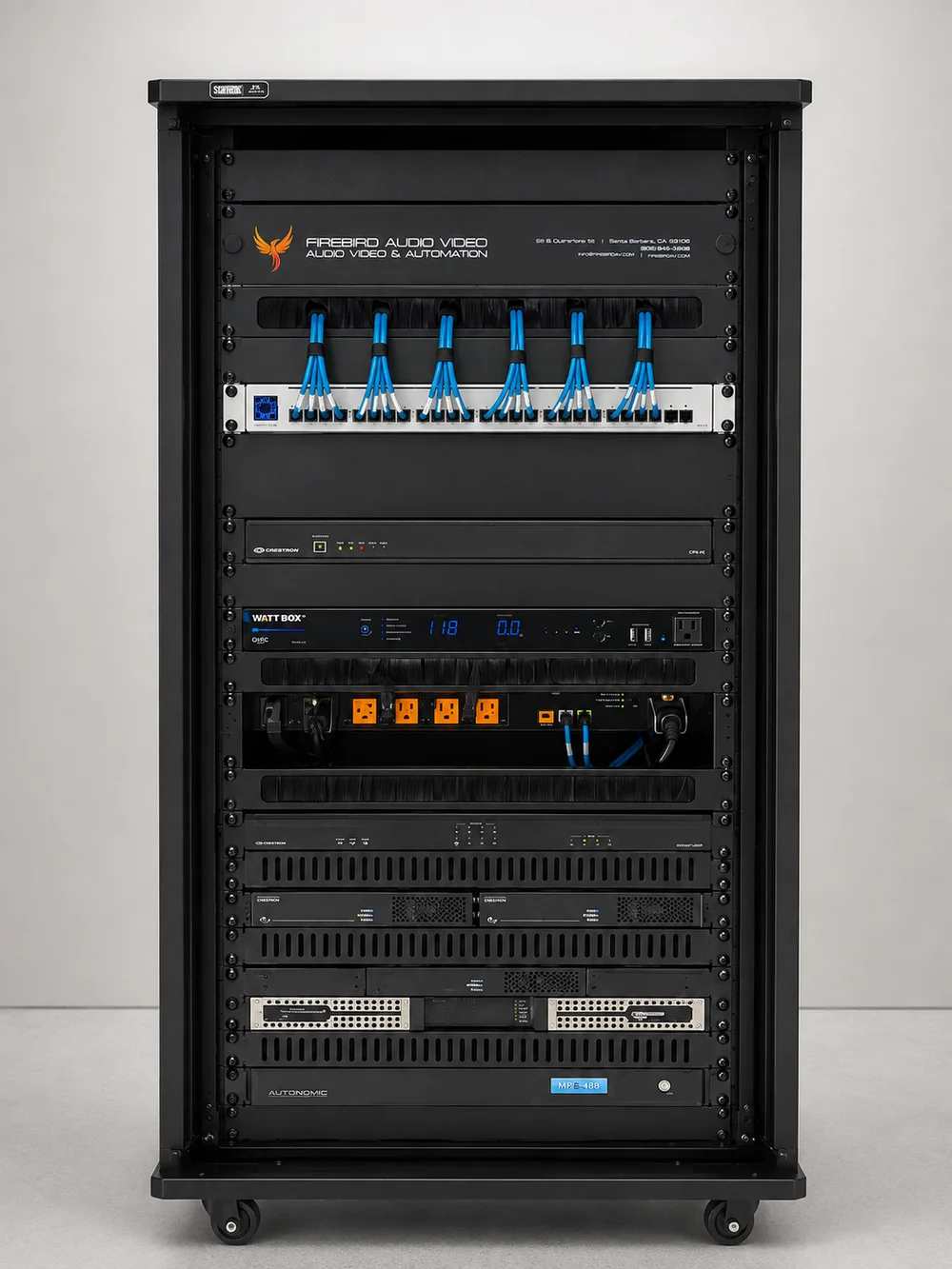
Photos of racks and rooms tell you about craft; conversations with clients three years in tell you about character. A confident integrator offers both without being asked twice. Read their Google reviews and notice whether reviewers mention what happened after the install.
7. How do you design — and will I get drawings?
Real integration is designed on paper before anyone touches a wall: wiring plans, rack layouts, device schedules, coordination with the architect and electrician. If the 'design process' is a walkthrough and a quote, the engineering is happening improvisationally, on your walls, at your expense.
8. What brands do you carry, and why those?
Listen for reasoning, not logos. A professional can explain why a platform fits your project — control ecosystems, lighting, speakers — and what they'd specify differently for a different home. Be wary of a one-brand answer to every question, and of anyone who bad-mouths the industry's serious platforms instead of explaining trade-offs.
9. How will you coordinate with my architect, builder, and electrician?
On a construction project, the integrator is a trade partner: attending meetings, issuing drawings on schedule, prewiring at the right phase, returning for trim and final. Ask how they've handled that rhythm before and whether the builder would work with them again. Technology installed as an afterthought looks like one forever.
10. What does this cost — and what's not included?
You want ranges early and a precise itemized proposal before contract, with exclusions in plain sight. A vague number that grows by change order is the oldest trick in the trade. An integrator confident in their pricing will show you how it's built — ours is public, on this site, as a calculator.
Frequently asked
What license does an AV installer need in California?+
Low-voltage systems work (audio, video, networking, control wiring) requires a C-7 Low Voltage Systems contractor's license from the CSLB; line-voltage lighting work requires appropriate electrical licensing. Verify any number at cslb.ca.gov before hiring — Firebird Audio Video operates under CSLB 1108192.
Should my AV company give me my network passwords?+
Yes, without qualification. Admin credentials for your network and systems belong to you and should be delivered in writing at project completion. Withholding credentials to guarantee future business is a red flag — and untangling it later is one of the most common reasons homes come to us for system takeovers.
What should be included in an AV proposal?+
An itemized scope: equipment by model, wiring and infrastructure, labor, programming, and calibration, with exclusions stated plainly. You should also see design drawings before construction and documentation at handoff. If the proposal is one number on one page, the engineering hasn't been done yet.