Audio · 6 min read
Ambisonic vs Sonance Landscape Speakers: A Santa Barbara Installer's Comparison
A Santa Barbara installer compares Ambisonic and Sonance outdoor landscape speakers: drivers, coverage, output and bass, plus what we heard side by side.
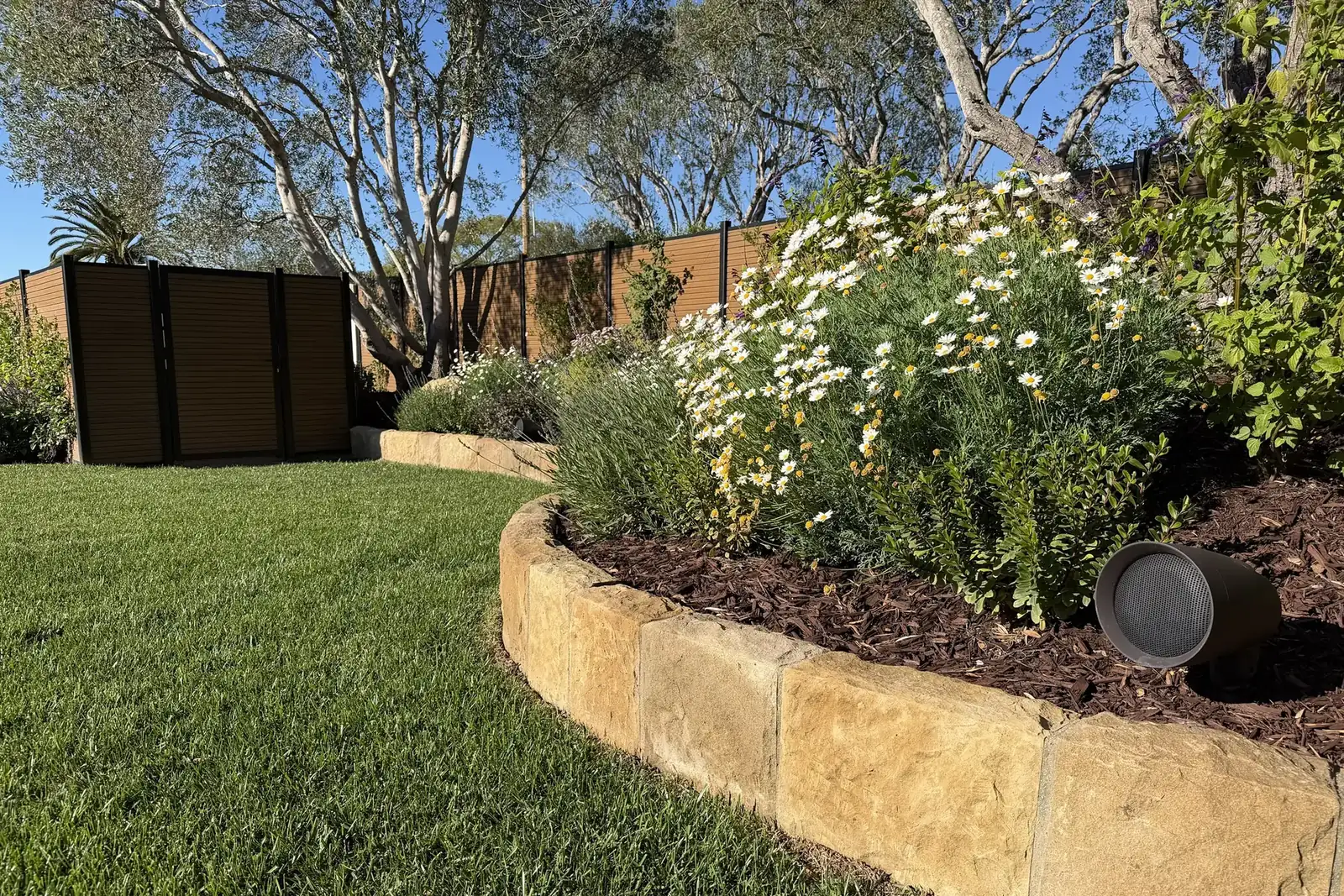
Ambisonic and Sonance both build landscape audio the same basic way: small satellite speakers staked into the planting beds, a subwoofer buried in the ground, and one amplifier in the equipment rack feeding the whole yard. The difference is in the drivers. Ambisonic uses a planar magnetic ribbon tweeter in every satellite. Sonance uses a 1 inch dome tweeter. That one choice explains most of what you hear outdoors, and it is the main reason we specify Ambisonic on most of our landscape systems.
Firebird AV designs and installs outdoor audio and landscape speakers in Santa Barbara, Montecito, Hope Ranch and the Santa Ynez Valley. This page compares the two on the numbers each maker publishes, and on what we have heard with both systems playing side by side.
The short version
- Ambisonic is stronger on clarity, coverage and output: a ribbon tweeter, a wide horizontal pattern and a subwoofer rated for far more power.
- Ambisonic is stronger on bass. Sonance publishes lower frequency numbers, but side by side the Ambisonic system plays deeper and louder where you are actually standing.
- Both are real landscape systems that run on 70 volt lines, hide in the planting and outperform a pair of patio boxes by a wide margin.
Satellites: Ambisonic LSR60 vs Sonance LS6T SAT
These are the mid-size satellites in each line and the ones most often used on a residential lawn.
| Ambisonic LSR60 | Sonance LS6T SAT | |
|---|---|---|
| Tweeter | 2.8 in planar magnetic ribbon | 1 in polyurethane dome |
| Woofer | 5.25 in glass fiber cone | 6.5 in polypropylene cone |
| Frequency response (+/- 3 dB) | 125 Hz to 20 kHz | 55 Hz to 20 kHz |
| Power | 75 W RMS | Up to 60 W (series figure) |
| Sensitivity | 88 dB | Not listed on the product page |
| Continuous output | 106 dB | Not listed on the product page |
| Wiring | 8 ohm or 70 V | 70 V or 100 V |
| Weather | Weather rated | Weather rated |
Why the ribbon tweeter matters outside
Indoors, walls and ceilings reflect sound back to you. Outdoors there is nothing to reflect it, so the high frequencies that carry vocals and detail fall away fast as you walk from the speaker. A dome tweeter is a small point source. A planar ribbon has a much larger radiating surface, which lets it play cleanly at higher output and hold its pattern across a wider area. Ambisonic publishes a horizontal coverage angle of 110 degrees or more for the LSR60, with a narrower vertical angle that keeps sound on the lawn instead of sending it over the fence.
In practice that means fewer hot spots. You can stand near one satellite without it sounding sharp, and the next seating area over still hears the lyrics.
What the bass numbers do and do not tell you
Sonance rates the LS6T SAT down to 55 Hz, below the LSR60's 125 Hz, and its subwoofer to a lower frequency as well. A frequency response figure tells you how low a speaker can reach. It does not tell you how much bass arrives at a seating area across the lawn in open air. That comes from power handling and output, and this is where the Ambisonic subwoofer pulls ahead.
We have heard the two systems side by side. The Ambisonic system has clearly more bass, and it stays tight as the volume goes up. Ambisonic gets there by keeping the satellites out of the low end entirely and handing it to a subwoofer built for the job, which is why we always design an Ambisonic system with one.
Subwoofers: Ambisonic 12BP-IG vs Sonance LS12T SUB
Both are 12 inch subwoofers buried in the ground with only a dome canopy showing above the mulch, about 17 inches across on each.
| Ambisonic 12BP-IG | Sonance LS12T SUB | |
|---|---|---|
| Design | Band-pass, double tuned | Vertically buried enclosure |
| Driver | 12 in long-throw, composite cone | 12 in polypropylene cone |
| Frequency response (+/- 3 dB) | 36 Hz to 140 Hz | 22 Hz to 100 Hz |
| Power | 1000 W RMS handling | Taps up to 300 W |
| Continuous output at 1 m | 123 dB | Not listed on the datasheet |
| Weather | Weather rated | Weather rated |
The Sonance subwoofer is rated to a lower frequency. The Ambisonic subwoofer handles more than three times the power and publishes its output, and that is what you hear outdoors: more bass, on a large lawn or anywhere the system has to compete with surf, wind or a crowd.
What matters in a Santa Barbara yard
- Open lawns facing the ocean: there are no walls to hold sound in, so wide coverage and clean output count for more than they do on a covered patio.
- Salt air: both lines are weather rated for permanent outdoor use. Near the water we also keep the amplifier indoors in the equipment rack.
- Santa Ynez Valley properties: the distance from the house to the pool or the barn can be long. Both lines run on 70 volt lines, which is what makes those runs practical.
- Close neighbors on the Riviera and the Mesa: more speakers played quietly keep the music on your side of the fence. That is a design choice and it applies to either brand.
Which one we specify
Firebird strongly prefers the sound of Ambisonic. We find them the best sounding landscape speakers available, and they are what we specify.
- Large lawns, pool decks and properties that entertain: Ambisonic. The ribbon satellites stay clear at volume and the subwoofer has the headroom.
- Listeners who care most about vocals and detail: Ambisonic.
- Bass you can feel across the yard: Ambisonic, with a buried subwoofer.
- The design still matters. Satellite count, aiming, zoning and amplifier power decide how a yard sounds.
Frequently asked
Is Ambisonic better than Sonance for outdoor speakers?+
For clarity, coverage and output, yes in our view. Ambisonic satellites use a planar magnetic ribbon tweeter and its buried subwoofer is rated for 1000 watts. Sonance publishes lower frequency figures on paper, but with both playing side by side the Ambisonic system has more bass. We specify Ambisonic on most landscape systems.
Do landscape speakers need a subwoofer?+
Almost always. Small satellites cannot produce low bass in open air. Ambisonic satellites are designed to hand everything below roughly 125 Hz to a buried subwoofer, so the system should be planned with one.
Who installs Ambisonic landscape speakers in Santa Barbara?+
Firebird AV designs and installs Ambisonic landscape audio in Santa Barbara, Montecito, Hope Ranch and the Santa Ynez Valley, and also takes outdoor audio projects in Malibu, Thousand Oaks, Oxnard and Ventura.
Can Ambisonic and Sonance landscape speakers run on the same amplifier type?+
Yes. Both lines run on 70 volt lines, which lets one amplifier in the equipment rack feed many speakers over long wire runs across a property.